Tribal Leadership: Summary & Key Lessons
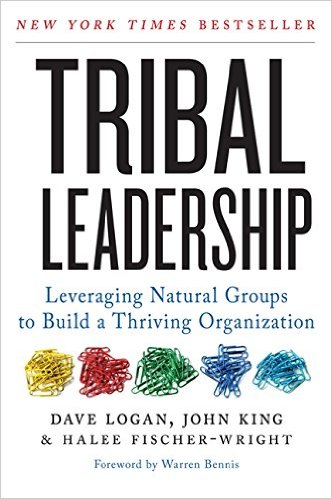
Tribal Leadership was developed based on the authors’ research involving approximately 24,000 people, and is rooted in a very straightforward notion — culture, not strategy, ultimately determines what a group can accomplish. This tribal leadership summary describes the model (Dave Logan, John King, and Halee Fischer-Wright) explaining why certain groups perform better than larger and more intelligent organizations, though largely in silence.
The authors identify “the tribe,” a naturally occurring group of about 20 to 150 people, as their unit of study. All work environments consist of numerous tribes, and each sits at one of five distinct stages of cultural development that you can determine by listening to how people speak to one another. (The idea overlaps with Seth Godin’s Tribes.)
The five stages of tribal culture
Stage One (“life sucks”) is characterized by a hostile and alienated atmosphere; fortunately, it is relatively rare in the workplace. In Stage Two (“my life sucks”) individuals within the group are disconnected and merely going through the motions, waiting until Friday afternoon. At Stage Three (“I’m great, and you’re not”) the vast majority of corporate cultures have been shaped by this level of competition among highly capable employees who wish to demonstrate their intellectual prowess over their colleagues and are unwilling to share knowledge with one another. Stage Four (“we’re great”) represents a trust-based culture among members of the same team working toward a common goal, using their collective intelligence to compete against external competitors rather than internally against one another. At Stage Five (“life is great”), this is a relatively rare and somewhat unpredictable stage of collaboration in pursuit of a world-changing project.
One of the major takeaways from Tribal Leadership is that it takes more than a single speech to elevate an entire tribe to the next stage. Rather, leaders develop a new culture by shaping the language used by individual members of the tribe, and by building “triads” — a small network of three members of the tribe tied together by shared values, thus creating a sense of unity and connection that is independent of the direction provided by the leader.
What it gets wrong
Although Tribal Leadership provides an excellent framework for understanding how an organization operates — the five-stage model is easy to understand — it does present a potential for simplification. Since no two groups are identical, and since many groups exhibit multiple characteristics at one time, a leader may find themselves reducing complex relationships into overly simplistic categories. Additionally, while Tribal Leadership offers powerful diagnostics for identifying where an organization falls, it does little to advise what actions to pursue when an organization is mired at a particular stage, or when a member of the team, particularly those at Stage Three, refuses to evolve. Lastly, while the examples offered in the book are primarily large organizations, readers who operate businesses of only two individuals will likely need to extend the concepts. Use Tribal Leadership as a source of inspiration and insight rather than as a cookbook-style guidebook.
Who should read it
Founders and managers whose livelihood depends upon what other people produce. As soon as your wealth depends upon others producing something valuable, culture becomes hard-edged and limits what you can accomplish. One easy exercise for this week: listen carefully to how often your team speaks in first-person singular pronouns (I/me) versus first-person plural pronouns (we/us). That ratio will tell you which stage your tribe is at quicker than any survey. For managing yourself while you manage the culture, pair it with The Effective Executive, and browse more in the business hub. To put a first team and system in place, see how to start an online business.
Tribal Leadership FAQ
What are the five stages of tribal leadership?
They run from Stage One (“life sucks”) and Stage Two (“my life sucks”), through Stage Three (“I’m great”), up to Stage Four (“we’re great”) and the rare Stage Five (“life is great”). Each stage shows up in the language a group uses.
What is tribal leadership in simple terms?
It is the idea that organizations are made of tribes of 20 to 150 people, and that leaders get the most leverage by upgrading a tribe’s culture one person at a time rather than dictating strategy.
What is a triad in Tribal Leadership?
A triad is a bond between three people built around shared values. Leaders form them by introducing two people to each other, which strengthens the network instead of routing everything through the boss.
Is Tribal Leadership worth reading?
Yes, if you lead a team and want a practical lens on culture. It is stronger on diagnosis than on fixes, so pair it with a more tactical management book.
As an Amazon Associate, Millionaires Books earns from qualifying purchases.